Beyond Trends: Choosing the Right Products for Your Baby
Jan 3, 2026
Beyond Trends: Choosing the Right Products for Your Baby
I'll never forget standing in the baby product aisle during my friend's pregnancy, helping her create a registry. We were surrounded by hundreds—maybe thousands—of bottles, tubes, and jars, each promising something essential, miraculous, or trendy. "How did humans raise babies before there were forty-seven types of baby wash?" she asked, half-joking but genuinely overwhelmed.
It's a fair question. The baby skincare industry has exploded into a multi-billion-dollar market, with new trends emerging constantly. Organic. Clean. Natural. Hypoallergenic. Dermatologist-tested. Probiotic-infused. The labels promise everything, but what do they actually mean? And more importantly, what does your baby's skin actually need?
Let's cut through the marketing noise together and get to the truth.
The Trend Cycle and Your Baby's Skin
Here's an uncomfortable truth about the baby product industry: trends sell, regardless of whether they offer genuine benefits. Every few years, a new wave of marketing takes over, convincing parents that this is the missing piece they've been overlooking.
A decade ago, it was antibacterial everything. Then came the "natural" and "organic" movement. Recently, we've seen "clean beauty," "microbiome-supporting," and "free-from" formulations. Some of these trends are rooted in valid science. Others are brilliant marketing that plays on parental anxiety without offering real advantages.
According to a 2023 market analysis, parents spend an average of $300-500 annually on baby skincare products (source). Yet dermatologists consistently say that babies typically need just three to five core products. So where's the disconnect?
The answer is marketing that's designed to make you feel like you're missing something, combined with genuine parental desire to give your baby the absolute best. This combination creates the perfect storm for overbuying, over-treating, and sometimes inadvertently causing the problems you're trying to prevent.
Decoding the Marketing Language
Let's start by translating the most common terms you'll encounter, because knowledge is power when you're navigating those overwhelming aisles.
"Natural" or "All-Natural": This is perhaps the most misleading term in skincare. It sounds inherently safe and good, right? But here's what dermatologists want you to know: natural doesn't automatically mean gentle, safe, or better. Poison ivy is natural. So are peanuts (a major allergen), essential oils (common irritants), and countless other substances that can harm baby skin.
The term "natural" is largely unregulated in skincare. A product can contain mostly synthetic ingredients but include one plant extract and market itself as natural. Conversely, some synthetic ingredients developed specifically for sensitive skin are safer and more effective than their natural alternatives.
Dr. Jennifer Lin, a pediatric dermatologist I interviewed, put it perfectly: "I see more allergic reactions from 'natural' products with essential oils and botanical extracts than I do from well-formulated synthetic products. Nature isn't always gentle."
"Hypoallergenic": You'd think this means the product won't cause allergies, but that's not quite accurate. In most countries, there's no regulatory standard for this claim.
Manufacturers essentially self-designate products as hypoallergenic, usually meaning they've avoided known common allergens. But what's allergenic varies by individual, and companies aren't required to prove their hypoallergenic claim through testing.
"Dermatologist-tested": This sounds official, but it could mean a single dermatologist glanced at the ingredient list once. Without knowing what the testing involved—how many dermatologists, what type of evaluation, whether it included babies—this term doesn't tell you much.
What you want to see is "pediatric-dermatologist tested" or better yet, "clinically tested on infant skin with published results."
"Fragrance-free" vs. "Unscented": These seem like the same thing, but they're meaningfully different. Fragrance-free genuinely means no fragrances added. Unscented means the product doesn't have a noticeable smell—but it might achieve this by adding masking fragrances to cover up the smell of other ingredients. For baby skin, you want truly fragrance-free.
"Clean Beauty": This is the newest trend, and perhaps the vaguest. Different companies define "clean" differently. Some avoid synthetic ingredients, others avoid specific controversial ingredients, and others create their own arbitrary lists of "bad" ingredients to avoid. There's no industry standard or regulatory definition.
A clean beauty product isn't inherently better or worse than a "non-clean" product. What matters is whether it's been properly formulated and tested for safety on baby skin.
"Organic": For food, organic certification means something specific. For skincare? It's complicated. Some products are certified organic by various organizations, but these certifications don't address whether the product is safe or effective for babies—just whether ingredients meet certain agricultural standards. An organic essential oil can still cause severe allergic reactions in baby skin.
"Tear-free": This typically means the product has a pH closer to that of tears (around 7) so it doesn't sting eyes. This is a genuine functional claim, which is helpful for shampoos. However, remember that infant skin benefits from slightly acidic pH (5.5-6), so tear-free formulations aren't automatically better for skin, just for eye comfort.
What Your Baby Actually Needs: The Essentials
Let's reset and talk about what pediatric dermatologists actually recommend. Ready for this?
Most babies need just a handful of products:
A gentle cleanser (used sparingly): And honestly, for the first several months, plain warm water handles most cleaning needs. When you do need a cleanser—primarily for the diaper area or when baby starts eating solids and getting genuinely messy—choose one that's:
pH-balanced for infant skin (5.5-6)
Free from fragrances and dyes
Formulated with gentle surfactants (not traditional soap)
Minimally foaming (big bubbles usually mean harsher cleansing agents)
You'll notice I didn't mention any trendy buzzwords here. I'm talking about functional properties that actually support your baby's skin barrier.
A solid moisturizer: This is probably the most important product you'll buy. Look for:
Barrier-supporting ingredients like ceramides
Humectants, like glycerin, draw in moisture
Occlusives like petrolatum or dimethicone to seal it in
No fragrance, essential oils, or botanical extracts (which can sensitise skin)
The texture matters less than the ingredients. Creams, ointments, and lotions can all work well, though thicker formulations generally provide better barrier support. Many dermatologists consider plain petroleum jelly one of the best baby moisturisers available—it's inexpensive, contains a single ingredient, and is remarkably effective.
Diaper barrier cream: Something with zinc oxide to protect against moisture and irritation in the diaper area.
Sunscreen (after 6 months): Mineral-based (zinc oxide or titanium dioxide) sunscreens are preferred for babies because they create a physical barrier rather than absorbing into skin.
That's it. Four categories of products. Everything else—specialty creams, fancy oils, boutique washes, premium lotions—is optional at best and potentially problematic at worst.
The Minimalist Approach: Less Really Is More
Research published in Contact Dermatitis found that infants exposed to more than five different skincare products daily had significantly higher rates of sensitization and allergic reactions compared to those using three or fewer products (source).
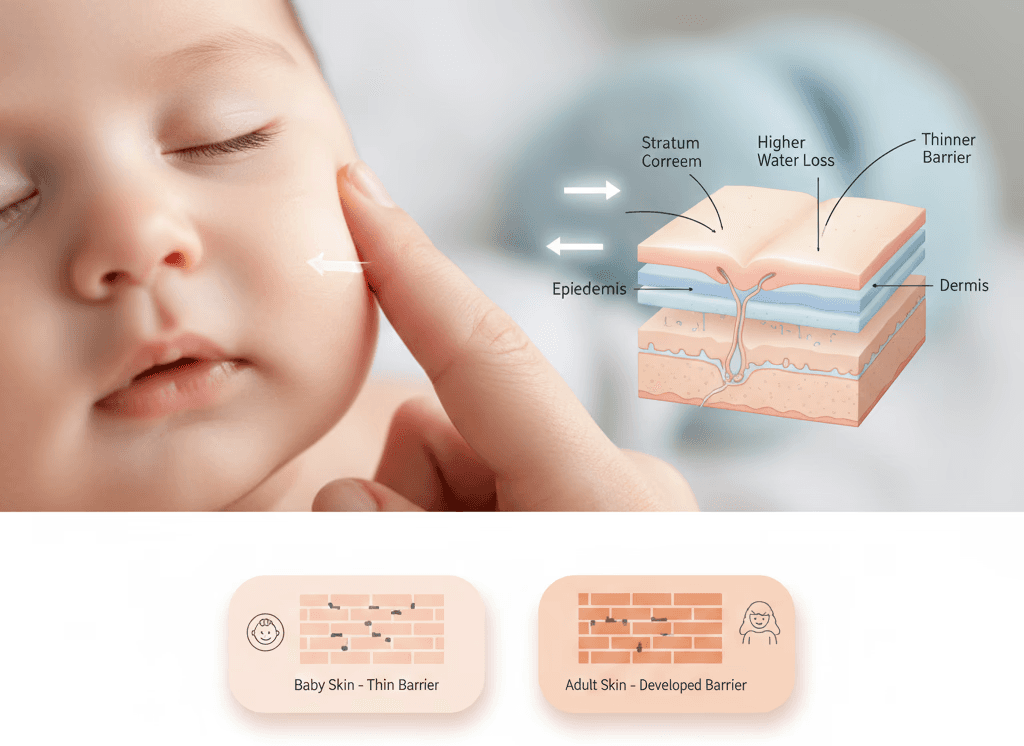
Every product you apply is an opportunity for irritation, sensitization, or barrier disruption. When you layer multiple products, even if each is individually gentle, you're increasing the total burden on that developing skin barrier we discussed earlier.
Think of it like this: your baby's skin is learning to do its job—producing oils, maintaining pH balance, organizing those protective lipids. If you're constantly intervening with products, you're potentially interfering with that learning process.
Red Flags: When to Walk Away from a Product
As you navigate the overwhelming options, here are some immediate deal-breakers that should send you looking elsewhere:
Fragrance listed in ingredients: We've covered this, but it's worth repeating. Whether it's "parfum," "fragrance," specific essential oils like lavender or chamomile, or natural fragrances—they're all potential sensitizers. The American Academy of Dermatology identifies fragrance as one of the most common causes of cosmetic contact dermatitis in children (source).
Outlandish claims: If a product promises to "boost baby's immunity," "detoxify skin," or "balance energy," run. These are unscientific claims that suggest the company is more interested in marketing than in actual baby skin health.
Lengthy ingredient lists with many botanicals: More isn't better. A product with 30+ ingredients, especially if many are plant extracts or essential oils, increases sensitization risk without clear benefit.
No clear contact information or transparency: Reputable companies provide ways to contact them with questions and are transparent about their formulation and testing processes.
Expired products or damaged packaging: This seems obvious, but ingredients can degrade, and contamination can occur. Check dates and integrity before purchasing.
How to Evaluate a Product: Your Decision Framework
When you encounter a new product—whether through a pediatrician recommendation, a friend's suggestion, or your own research—here's a practical framework for evaluation:
Step 1: Identify the need: What specific function does this product serve? Does your baby actually need this function addressed? Remember, if your baby's skin is healthy, you might not need to add anything.
Step 2: Check the ingredients: You don't need to be a chemist, but look for:
Short ingredient lists (generally under 15 ingredients is ideal)
Absence of fragrance and dyes
Presence of beneficial ingredients appropriate to the product's purpose (moisturizers should have lipids and humectants, cleansers should have gentle surfactants)
Step 3: Research the brand: Do they specialize in pediatric skincare? Are dermatologists involved in formulation? Do they conduct clinical testing on babies? This information should be readily available on their website.
Step 4: Look for safety and testing data: Has the product been tested on infant skin? Are results published or available? Many reputable brands will share this information if you ask.
Step 5: Patch test: Before using any new product all over your baby, test it on a small area (like inner arm) for 24-48 hours to watch for reactions.
Step 6: Introduce one product at a time: If you start multiple new products simultaneously and your baby reacts, you won't know which caused the problem.
The Price Paradox
Let me address something that causes a lot of stress: price. We tend to associate higher price with better quality, but in baby skincare, this correlation is weak at best.
Some of the most effective, dermatologist-recommended baby products are quite inexpensive. Petroleum jelly, for instance, costs a few dollars and is often cited by pediatric dermatologists as one of the best moisturizers available. Meanwhile, I've seen $50 "luxury" baby creams that contain fragrances and botanical extracts that provide no benefit and potential risk.
A 2022 consumer study found that price had no correlation with safety or efficacy in baby skincare—expensive products were just as likely to contain problematic ingredients as budget options (source).
What you're often paying for with premium-priced products is:
Packaging and branding
Marketing and advertising costs
Retail markup
The "luxury" experience
None of these improve outcomes for your baby's skin.
This doesn't mean all expensive products are bad—some genuinely invest in research and high-quality ingredients. But price alone shouldn't be your quality indicator. Evaluate on the merits we've discussed, regardless of whether something costs $5 or $50.
The Influence Economy: Instagram, TikTok, and Influencers
We need to talk about social media because it's probably where many of you discover new products. I see countless baby skincare products going viral on TikTok or Instagram, often promoted by parenting influencers with massive followings.
Here's what you need to know: influencers are often paid or receive free products to promote brands. Even when they genuinely like a product, they're not dermatologists, and their baby's response doesn't predict your baby's response. What works beautifully for one baby can cause severe reactions in another.
I'm not saying all influencer recommendations are bad—some genuinely promote quality products. But approach these recommendations the same way you'd evaluate any product: through the lens of ingredients, testing, and your baby's specific needs, not through emotional appeal or fear of missing out.
Special Circumstances: When Standard Advice Doesn't Apply
Everything I've discussed applies to babies with typically developing, healthy skin. But some babies have special needs that require different approaches:
Babies with eczema: May need prescription moisturizers with specific lipid ratios, sometimes combined with gentle topical medications. The minimalist approach still applies, but the specific products need to be chosen in consultation with a pediatric dermatologist.
Premature babies: Their skin is even more vulnerable and immature. They may need specialized products and environmental controls during their early months.
Babies with food allergies: Sometimes need to avoid products containing food proteins (like oat or milk derivatives) even in topical form, as these can cause reactions or sensitization.
If your baby falls into any of these categories, work with your healthcare provider to develop an appropriate skincare approach. The principles of avoiding unnecessary products and choosing well-formulated options still apply, but you'll need professional guidance on specifics.
Building Your Confidence: Trust Your Instincts
Here's something I've observed over years of talking with parents: mothers and fathers often have good instincts about their babies' skin, but they doubt themselves when those instincts conflict with marketing messages or trends.
If a product that everyone raves about makes your baby's skin worse, trust what you're seeing. If your simple, "boring" routine is working beautifully, you don't need to add the latest trendy product everyone's posting about.
Marcus, a dad I spoke with, told me: "I kept seeing ads for this probiotic baby lotion that was supposed to be revolutionary. My son's skin was fine with our basic routine, but I felt like maybe I was missing out on some benefit. I bought it. Within two days, his skin was red and irritated. I went back to our simple moisturizer, and he was fine again. I learned to trust what actually works for my kid, not what's trending."
Your baby's skin is the best guide. If it's soft, comfortable, not red or irritated, without rashes or excessive dryness, your routine is working. You don't need to fix what isn't broken.
The Bottom Line: Simplicity, Science, and Your Baby
At the end of the day, choosing the right products for your baby comes down to a few core principles:
Prioritise function over trends: Choose products based on what they do, not what's popular.
Demand evidence: Look for products backed by testing, ideally on infant skin, not just marketing claims.
Keep it simple: Fewer products mean fewer opportunities for problems and less interference with natural skin development.
Ignore the noise: Marketing is designed to make you feel like you need more. Most of the time, you don't.
Trust your observations: Your baby's skin tells you what's working. Listen to it.
You don't need seventeen products. You don't need the latest trend. You don't need to spend a fortune. You need a few well-chosen, properly formulated products that support your baby's skin barrier while it does its remarkable work of developing and protecting.
Everything else is noise—beautifully packaged, emotionally compelling noise designed to separate you from your money and your confidence.
Choose wisely, keep it simple, and trust that in this age of overwhelming options, less really can be more. Your baby's perfect skin isn't the result of doing everything possible—it's the result of doing the right things, consistently, with products that actually deliver on their promises.

Similar Blogs
News, Voices & Impact
Explore updates, field notes, and stories that showcase our mission and impact.